홍채임상학 | Clinical Iridology
홍채임상학은 눈의 홍채에 나타나는 다양한 형태와 특징을 관찰하고 이해하기 위해 연구해 온 분야입니다.
저자 최만규는 오랜 기간 홍채임상학을 연구하고 교육하면서 축적한 경험을 바탕으로 『홍채임상학-아름다운 눈 건강을 말해요』를 집필하였습니다.
이 페이지에서는 홍채의 기본 구조와 홍채학의 역사, 홍채 관찰의 기본 개념, 저자의 연구·교육 자료를 차례로 소개합니다.
※ 이 페이지의 내용은 홍채임상학에 관한 교육 및 정보 제공을 목적으로 하며, 질병의 진단이나 의학적 치료를 대신하지 않습니다.
Clinical iridology is a field concerned with observing and studying the visible structures and characteristics of the iris.
Based on many years of research and teaching experience in iridology, author Man-Kyu Choi wrote Clinical Iridology – Beautiful Eyes Speak About Health.
This page introduces the basic structure of the iris, the history of iridology, fundamental concepts of iris observation, and educational materials based on the author’s research and teaching experience.
※ This content is provided for educational and informational purposes and is not intended to replace professional medical diagnosis or treatment.
저서 소개 | Publication
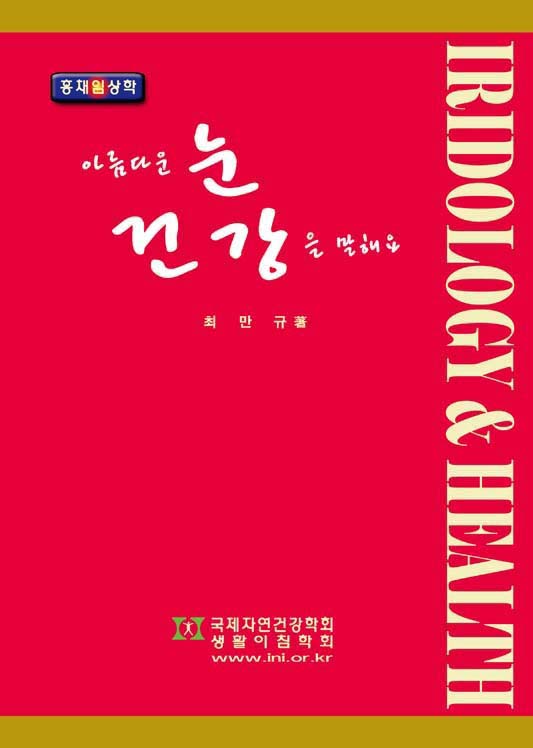
홍채임상학 – 아름다운 눈 건강을 말해요
Clinical Iridology – Beautiful Eyes Speak About Health
저자: 최만규
Author: Man-Kyu Choi
홍채에 나타나는 다양한 특징을 관찰하고 이해하기 위해 저자의 연구와 임상 경험을 체계적으로 정리한 저서입니다. 홍채학의 기본 개념과 실제 관찰에 관한 내용을 소개합니다.
This book presents the author’s research and practical experience in observing and understanding various characteristics of the iris, introducing the basic concepts and observational approaches of clinical iridology.
홍채학의 역사 | History of Iridology
홍채학의 역사
근대 홍채학의 역사는 헝가리 의사 이그나츠 폰 펙첼리(Ignaz von Peczely)의 관찰에서 시작된 것으로 널리 소개되고 있습니다.
1826년 헝가리에서 태어난 펙첼리는 어린 시절 다리가 다친 올빼미의 눈을 관찰하면서 홍채에 나타난 변화에 관심을 갖게 되었다고 전해집니다. 이후 의사가 된 그는 환자들의 건강 상태와 홍채에서 관찰되는 여러 특징 사이의 관계를 연구하면서 근대 홍채학의 기초를 마련하였습니다.
그는 위장이나 척추를 비롯한 신체의 여러 부위에 문제가 있는 환자들의 홍채에서 일정한 특징이 반복되어 나타나는 현상에 관심을 갖고 임상적인 관찰을 계속하였습니다. 이러한 연구를 통해 홍채의 특정 영역과 인체의 여러 부위를 연관하여 이해하려는 초기 체계가 발전하게 되었습니다.
이후 스웨덴의 닐스 릴리에퀴스트(Nils Liljequist)는 눈과 홍채 관찰에 관한 연구를 발전시켰으며, 그의 연구가 영어권에 소개되면서 홍채학은 미국을 비롯한 여러 지역으로 확산되기 시작했습니다.
20세기에 들어서면서 유럽과 미국을 중심으로 홍채학에 관한 연구와 저술이 더욱 활발해졌습니다.
미국에서는 버나드 젠슨(Bernard Jensen)이 오랜 기간 자연건강 분야에서 활동하면서 많은 사람들의 홍채를 관찰하고 관련 자료를 정리하였습니다. 그는 오늘날에도 여러 홍채학 교육 분야에서 사용되고 있는 홍채 차트의 발전과 홍채학 교육의 체계화에 큰 영향을 끼친 인물로 알려져 있습니다.
독일에서는 요제프 데크(Josef Deck)가 홍채의 여러 징후와 체질적·유전적 특징 등에 관한 연구를 발전시키면서 독일 홍채학의 학문적 체계를 정리하는 데 기여하였습니다.
러시아에서는 신경병리학 분야의 E. Velkhover 등이 홍채 관찰과 임상 분야를 연구하였으며, 홍채와 신체적·심리적 특성 등에 관한 다양한 연구가 이어졌습니다.
불가리아의 P. Dimkov는 전통적인 자연건강 분야와 홍채 관찰에 관한 저술을 남겼으며, 프랑스의 R. Bourdiol 역시 홍채의 구조와 색소 및 여러 관찰 특징에 관한 연구를 발전시키는 데 기여하였습니다.
미국의 Harry Wolf를 비롯한 여러 연구자들도 홍채와 심리·신체적 특징의 관계를 연구하는 등 현대 홍채학의 다양한 분야를 발전시켰습니다.
한국에서는 정확한 최초 도입 시기를 특정하기 어렵지만 1980년대 말부터 자연요법과 관련된 분야를 중심으로 홍채학이 소개되기 시작하였으며, 1990년대 들어 교육과 연구 활동이 점차 확대되었습니다.
1998년에는 대한홍채의학회가 창립되는 등 국내에서도 홍채학을 연구하고 체계화하려는 움직임이 이어졌습니다. 이후 홍채와 관련된 연구와 학술 활동에 참여하는 사람들이 증가하면서 국내에서도 다양한 연구와 교육이 이루어져 왔습니다.
오늘날 홍채학은 국가와 학문 분야에 따라 평가와 활용 범위가 서로 다릅니다. 특히 홍채의 특징만으로 특정 질병을 진단할 수 있다는 주장에 대해서는 현대 의학적 근거가 충분히 확립되어 있지 않으므로, 홍채 관찰은 의학적 검사나 전문적인 진단을 대신해서는 안 됩니다.
이 페이지에서는 이러한 역사적 배경을 바탕으로 홍채의 구조와 특징, 홍채 관찰에 관한 교육 자료와 저자의 연구 경험을 차례로 소개합니다.
History of Iridology
The modern history of iridology is commonly associated with the observations of Hungarian physician Ignaz von Peczely, who was born in Hungary in 1826.
According to accounts commonly told in the history of iridology, Peczely became interested in the iris after observing the eye of an injured owl during his youth. He reportedly noticed changes in the appearance of the owl’s iris during its recovery. This experience is traditionally described as an early influence on his later interest in relationships between visible characteristics of the iris and the human body.
After becoming a physician, Peczely continued observing the irises of his patients and attempted to identify recurring patterns associated with different physical conditions. His work contributed to the development of early systems that associated particular regions of the iris with different areas of the body.
Nils Liljequist of Sweden subsequently contributed to the development of iris observation and related research. As European writings on the subject became available to English-speaking readers, interest in iridology gradually spread to the United States and other countries.
During the twentieth century, research, teaching, and publications concerning iridology expanded in Europe and North America.
In the United States, Bernard Jensen became one of the best-known figures associated with modern iridology. Through many years of work in natural health, he documented numerous iris observations and contributed to the development and popularization of iris charts that have been widely used in iridology education.
In Germany, Josef Deck contributed to the systematic study of iris signs and constitutional characteristics and became an influential figure in the development of German iridology.
Researchers in Russia, including E. Velkhover, also explored clinical iris observation and various proposed relationships between iris characteristics and physical or psychological features.
In Bulgaria, P. Dimkov wrote about traditional natural health practices and iris observation. In France, R. Bourdiol contributed to research and writing concerning iris structures, pigmentation, and other observable characteristics.
Researchers such as Harry Wolf in the United States further explored psychological and physiological perspectives associated with iris observation, contributing to the development of different schools of modern iridology.
In Korea, the exact date of the earliest introduction of iridology is difficult to establish. However, the subject began to receive greater attention in natural-health circles from the late 1980s, with educational and research activities expanding during the 1990s.
The establishment of the Korean Society of Iridology Medicine in 1998 was among the developments that contributed to organized study and education in the field. Since then, researchers and practitioners in Korea have continued to explore various aspects of iris observation.
Today, the status and use of iridology vary considerably among countries and professional fields. Claims that specific diseases can be diagnosed solely from iris characteristics have not been established by sufficient modern medical evidence. Iris observation therefore should not be used as a substitute for medical examinations, professional diagnosis, or treatment.
This page presents educational information about the structure and characteristics of the iris, the history of iridology, and the author’s research and teaching experience within this historical context.
홍채의 기본 구조 | Basic Structure of the Iris
홍채의 기본 구조
홍채(Iris)는 눈의 앞부분에서 동공(Pupil)을 둘러싸고 있는 원형의 조직으로, 우리가 흔히 눈의 색깔이라고 부르는 부분입니다.
홍채의 중앙에는 빛이 들어오는 통로인 동공이 있으며, 홍채는 주변의 빛의 양에 따라 동공의 크기를 조절하는 데 중요한 역할을 합니다.
홍채를 자세히 관찰하면 사람마다 색상과 무늬, 섬유의 배열 등 다양한 특징을 볼 수 있습니다. 이러한 특징은 개인마다 차이가 있으며 나이, 유전적 특성 등 여러 요인의 영향을 받을 수 있습니다.
홍채학을 공부하기 위해서는 먼저 동공, 홍채, 공막 등 눈의 기본적인 해부 구조와 각각의 위치를 정확하게 이해하는 것이 중요합니다.
이 페이지에서는 이러한 기본적인 눈의 구조를 먼저 이해한 뒤, 홍채에서 관찰되는 여러 특징과 홍채학에서 사용되는 용어들을 차례로 소개합니다.
※ 홍채의 외형적 특징만으로 질병을 진단하거나 건강 상태를 단정해서는 안 됩니다. 본 내용은 홍채학에 관한 교육 및 정보 제공을 목적으로 합니다.
Basic Structure of the Iris
The iris is the circular structure surrounding the pupil at the front of the eye and is responsible for much of what we commonly describe as eye color.
At the center of the iris is the pupil, the opening through which light enters the eye. The iris plays an important role in regulating the amount of light entering the eye by controlling pupil size.
When viewed closely, the iris displays variations in color, patterns, and structural appearance. These characteristics differ among individuals and may be influenced by factors such as genetics and age.
Before studying iridology, it is important to understand the basic anatomy and location of structures such as the pupil, iris, and sclera.
This page begins with these basic anatomical concepts and will subsequently introduce visible iris characteristics and terminology commonly used in the study of iridology.
※ Visible characteristics of the iris should not be used by themselves to diagnose disease or determine a person’s health status. This material is provided for educational and informational purposes.
홍채(Iris)에서 반영되는 몸 | The body reflected in the iris
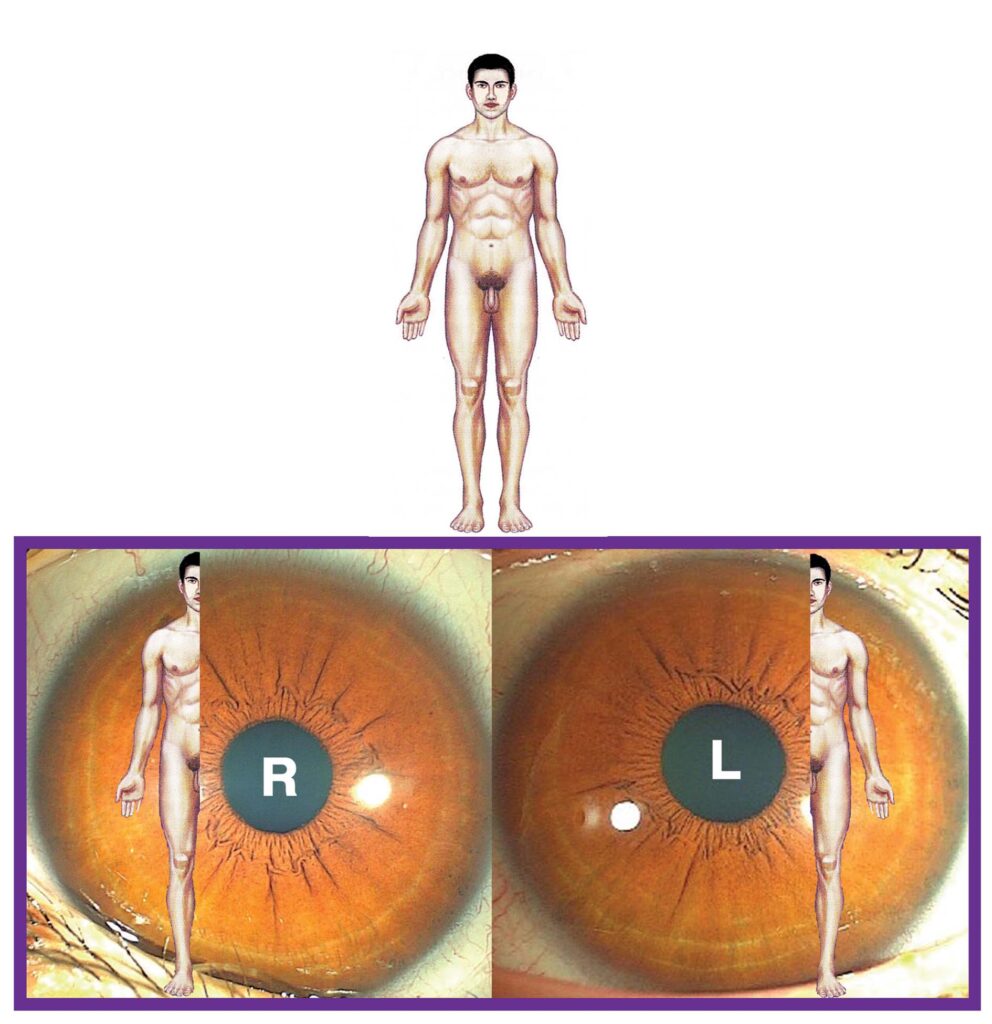
홍채분석차트 | Iris analysis chart
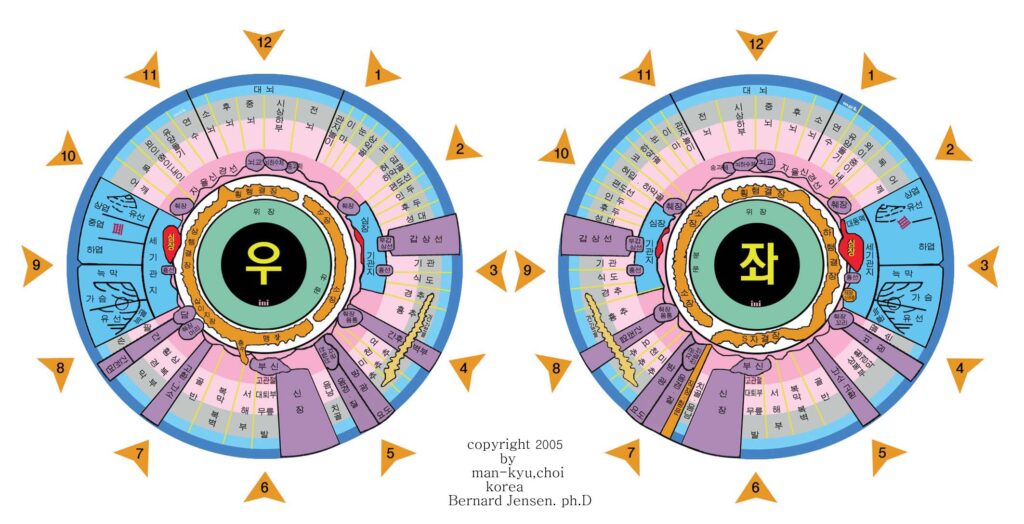
홍채 관찰의 기본 원리 | Basic Principles of Iris Observation
홍채 관찰의 기본 원리
홍채를 관찰할 때에는 특정한 한 부분만을 보는 것이 아니라 홍채 전체의 구조와 색상, 무늬, 섬유의 배열, 동공의 형태와 주변 조직의 특징 등을 종합적으로 살펴보는 것이 중요합니다.
사람의 홍채는 개인마다 서로 다른 특징을 가지고 있습니다. 따라서 홍채를 공부할 때에는 먼저 정상적인 홍채의 기본 구조와 개인별 차이를 충분히 이해한 뒤 여러 특징을 차례로 관찰하는 것이 좋습니다.
홍채를 관찰할 때에는 다음과 같은 기본적인 순서로 접근할 수 있습니다.
1. 좌우 홍채의 전체적인 형태와 색상을 관찰합니다.
2. 동공의 위치와 형태를 살펴봅니다.
3. 홍채 섬유의 배열과 전체적인 무늬를 관찰합니다.
4. 홍채에서 보이는 색소와 색상의 차이를 살펴봅니다.
5. 좌우 홍채에서 관찰되는 특징을 서로 비교합니다.
6. 한 가지 특징만으로 판단하지 않고 전체적인 관찰 내용을 종합하여 이해합니다.
홍채학에서는 홍채의 여러 영역을 구분하여 관찰하기 위한 다양한 차트와 교육 자료가 사용되어 왔습니다. 이러한 자료는 홍채의 위치와 특징을 체계적으로 공부하는 데 참고할 수 있습니다.
그러나 홍채에서 관찰되는 특정 색상이나 무늬, 형태만으로 질병의 존재 여부를 판단하거나 특정 질환을 진단해서는 안 됩니다. 홍채 관찰은 홍채학을 이해하기 위한 교육적 관찰의 한 방법으로 접근하는 것이 중요합니다.
저자 최만규는 오랜 기간 홍채학을 연구하고 교육하면서 축적한 자료와 경험을 바탕으로 『홍채임상학-아름다운 눈 건강을 말해요』를 집필하였습니다. 이 페이지에서는 이러한 연구와 교육 경험을 토대로 홍채의 구조와 관찰 방법을 단계적으로 소개합니다.
※ 본 내용은 홍채학에 관한 교육 및 정보 제공을 목적으로 하며 의학적 진단, 검사 또는 치료를 대신하지 않습니다.
Basic Principles of Iris Observation
When observing the iris, it is important to consider its overall appearance rather than focusing on a single feature. General structure, color, patterns, fiber arrangement, pupil shape, and other visible characteristics can all be observed as part of a systematic study of the iris.
Every person’s iris has individual characteristics. For this reason, students of iridology should first become familiar with the basic anatomy of the iris and normal individual variations before examining particular features in greater detail.
A basic observational approach may include the following steps:
1. Observe the overall appearance and color of both irises.
2. Examine the position and shape of the pupils.
3. Observe the general patterns and arrangement of iris fibers.
4. Note visible variations in pigmentation and coloration.
5. Compare observable characteristics between the left and right irises.
6. Consider observations as a whole rather than drawing conclusions from a single feature.
Various charts and educational materials have been developed within iridology to organize different areas of the iris and assist students in studying their locations and observable characteristics.
However, a particular iris color, pattern, or structural feature should not by itself be interpreted as evidence of a disease or used to diagnose a medical condition. Iris observation is best approached as an educational method for studying the visible characteristics of the iris.
Based on many years of research and teaching experience in iridology, author Man-Kyu Choi wrote Clinical Iridology – Beautiful Eyes Speak About Health. This page introduces the structure of the iris and methods of observation step by step, drawing on that research and educational experience.
※ This material is provided for educational and informational purposes and is not intended to replace professional medical diagnosis, examination, or treatment.
헤딩
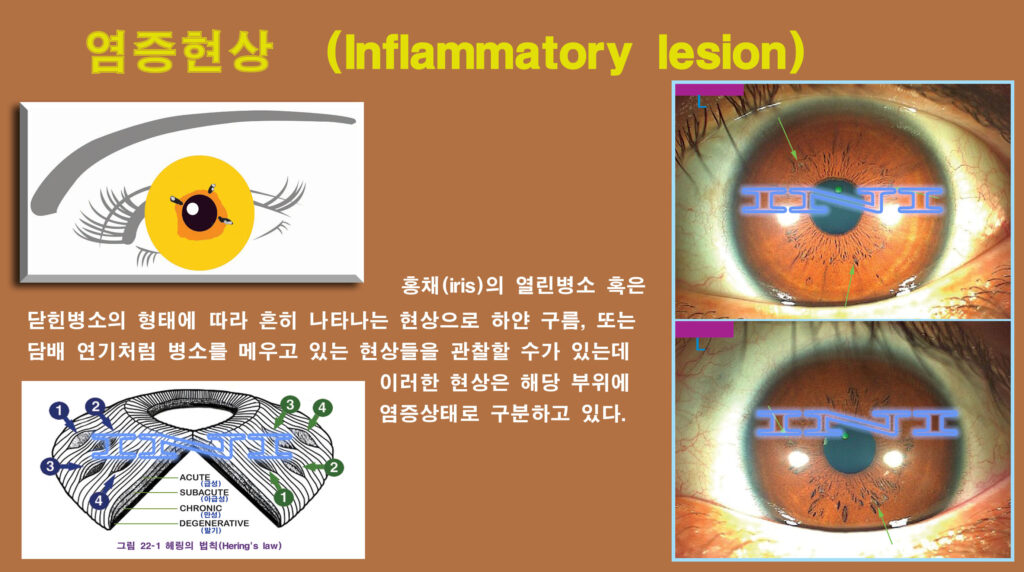
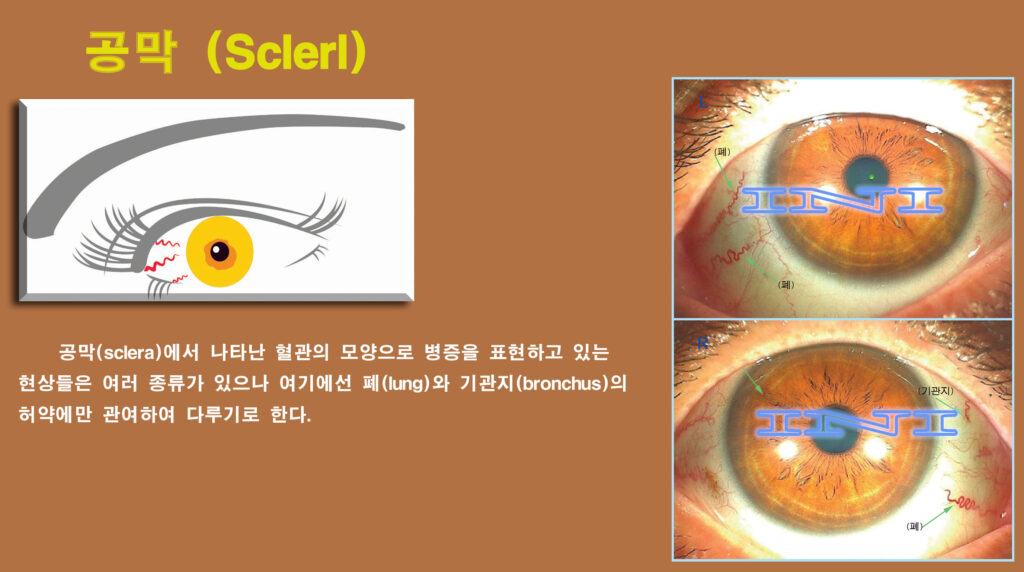
염중현상(Inflammatory lesion)
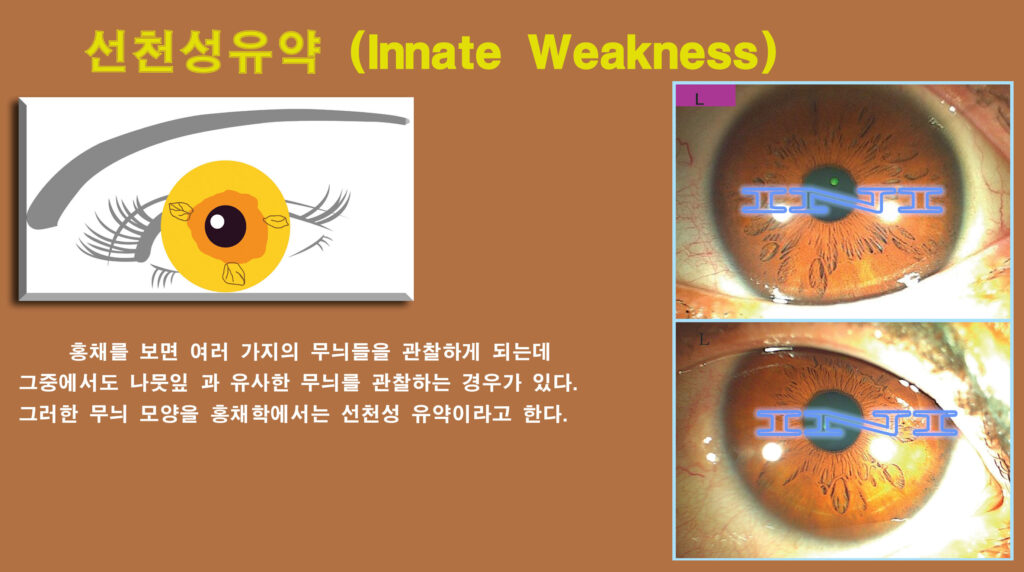
선천성유약(Innate Weakness)
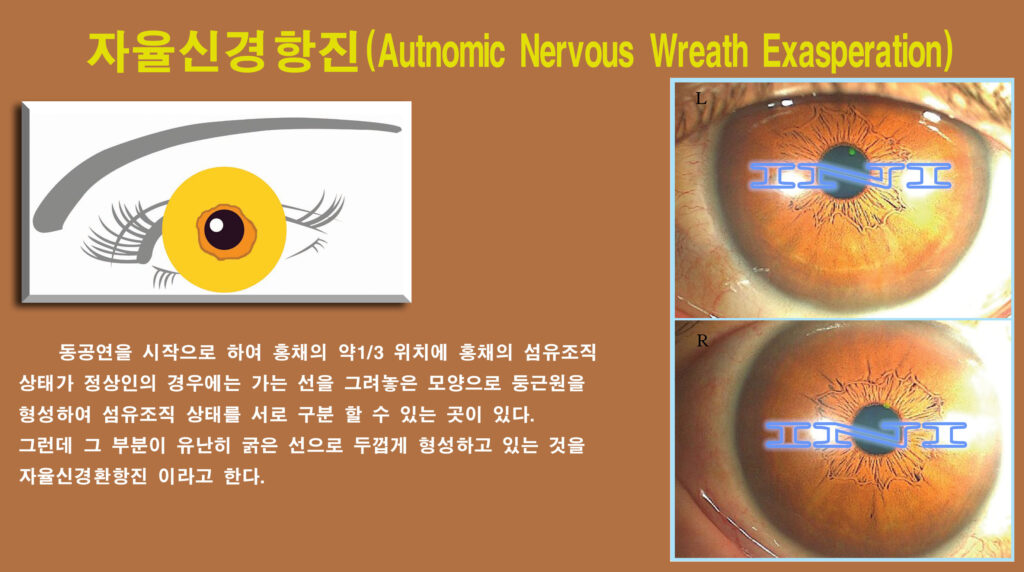
자율신경환항진 (Autnomic Nervous Wreath Exasperation)
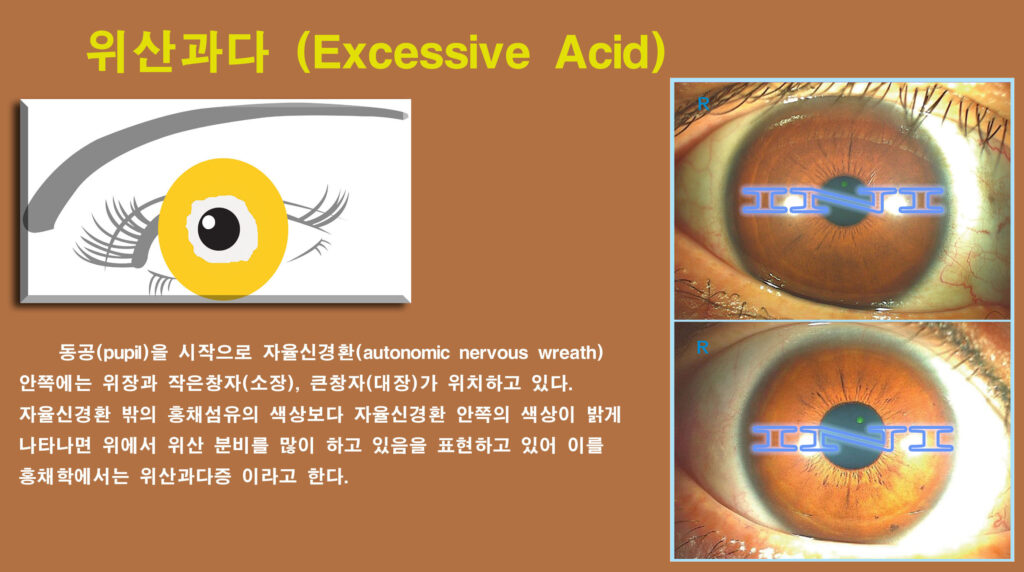
위산과다 (Excessive Acid)