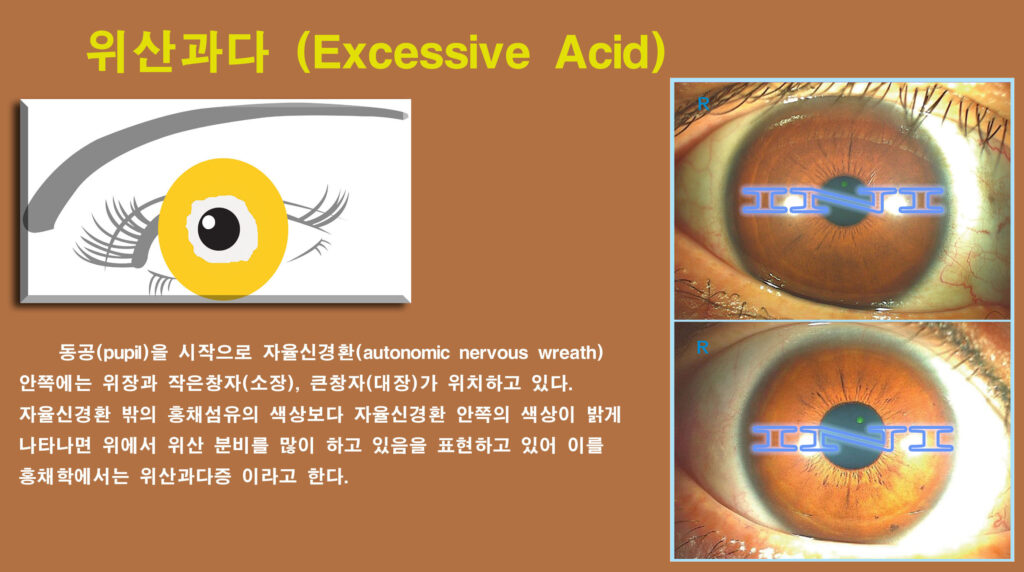
위산과다는 위액의 분비가 많음으로써 위에 산도가 높음을 말한다. 음식물이 식도를 거쳐 위로 들어와 위점막에 자극을 주면 위에서는 음식물들을 소화 흡수하기 위해 위샘(gastric gland)에서는 위액(gastric juice)을 분비 하고 점액세포(mucus cell)에서는 점액을, 주세포(chief cell)에서는 단백질을 분해하는 펩시노겐(pepsinogen)을, 벽세포(parietal cell)에서는 염산(HCI)을 분비하고 있다.
염산은 외부로부터 음식물과 함께 들어온 각종 세균들을 사멸시키며 음식물이 부패 되는것을 방지 하고 점액세포에서 나온 점액(mucus)은 위벽을 싸고 있어 벽세포에서 나온 강한 염산과 펩시노겐(pepsinogen)으로 활성화된 펩신(pepsin)에 의해 위벽에 큰 손상을 끼칠 수 있는 위벽을 보호하는 역할을 하고 있다.
그러나 점액세포의 손상으로 점액분비의 부족현상이 생기면 위산과다 현상이 나타나면서 산은 곧바로 위 내벽을 공격하게 되어 염증을 일으키기도 하며 소화성 궤양을 유발 시킨다.
헬리코박터파일로리균(Helicobacter pylori)에 감염되면 헬리코박터파일로리균이 점액층의 기능을 감소시키는 물질을 방출하고 있다. 산성소화액은 위나 샘창자의 내벽을 부식시키며 소화성 궤양(ulcer)으로 발전해 나간다.
위염(gastritis) 증상은 주로 식전 공복에 위 부위에서 심한 통증을 느끼게 되며 식욕감퇴와 오심구토를 호소하는데 음식을 섭취하면 통증은 쉽게 사라진다.
궤양 증상으로는 위염과 같은 증상을 느끼면서 주로 새벽에 복부통증을 심하게 갖는데 이러한 사람들은 평소에 복부 팽만감과 체중감소가 일어나는 것에 주위 해야 한다.
Excessive Acid
Starting from the pupil towards the inside of the autonomic nervous
w reath, there is the stomach, small and large intestines. When the color inside of the autonomic nervous ring is lighter than that of the pupil outside of it, this is indicative of stomach hyperacidity, meaning that acidity within the stomach is
abnormally high due to excess release of acid. Food that enters the stomach via the esophagus stimulate the stomach’s mucous membrane to release gastric juices from the gastric glands.
The mucus is released from the mucous cells, the protein digesting pepsinogen from the chief cell and HCl from the parietal calls. HCl is beneficial in that it can destroy various germs that enter the stomach with the consumed food and hence, resisting food decay.
The mucus covers the surface of the stomach walls as to resist the corroding effect from the activated pepsinogen, pepsin and HCl. If the mucosa cells are somehow impaired however, the lack of mucus leads to a relatively high acid concentration that corrodes the stomach walls causing inflammation and then possibly stomach ulcer. When someone is infected with the Helicobacter pylori bacteria, which release s ubstances that reduce the effect of the mucus layer that cause corrosion in the stomach walls and possibly ulcer.
The symptoms of gastritis include severe pain in the empty stomach before a meal, as well as reduced appetite and nausea. However, it is resolved when food is consumed but for ulcers, there is also an additional symptom where there is severe pain in the abdomen during early mornings.
Such people should beware of feelings of inflation in the abdomen and loss of weight.